
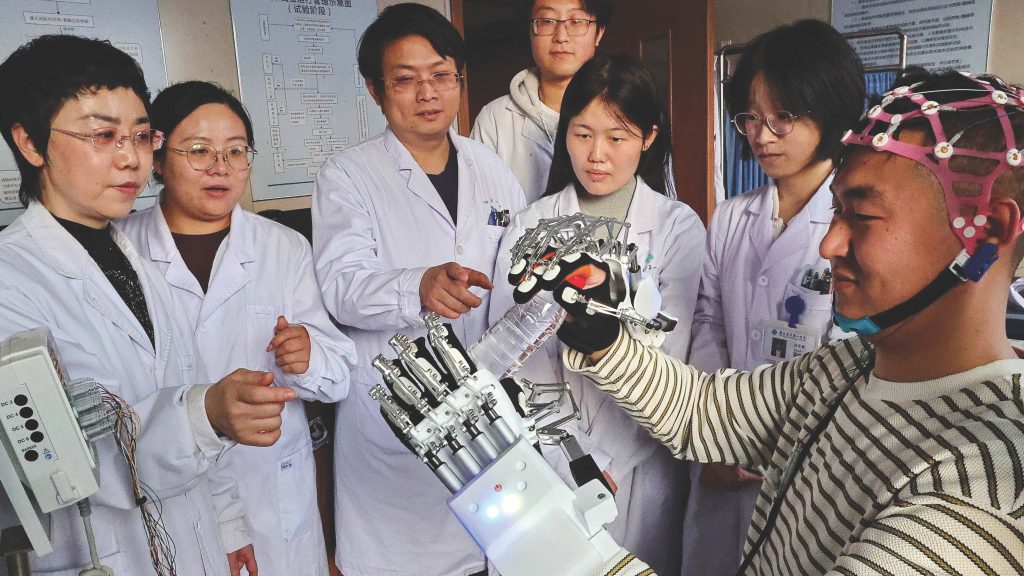
NMPA released the final guideline “Clinical Trial Key Points on Implanted Brain-Computer Interface (BCI) Hand-Movement Compensation Systems” on October 22, 2026. The draft version was issued in July 2026 for feedback.
Referenced by the FDA Implanted Brain-Computer Interface (BCI) Devices for Patients with Paralysis or Amputation – Non-clinical Testing and Clinical Considerations, the review points require a clinical trial—not bench/animal data alone—to confirm integrated safety and effectiveness; sufficient overseas data may be accepted. A feasibility trial of ≥4 same-indication cases is recommended. A single-arm objective-performance-goal design is allowed where no effective treatment exists and no neural-repair claim is made. The primary endpoint is the 6-month BCI-assisted ARAT grasping response rate, with MCID generally ≥2 points and sample size justified (e.g., ≥32). Follow-up should be ≥6 months. The IFU must define calibration/retraining thresholds, MRI status and use environments. Post-market follow-up of ≥2 years should collect real-world signal stability, decoding accuracy, performance degradation, mental burden and safety data.
China Med Device can help you with early gap analysis against these expectations that reduces regulatory risk. info@ChinaMedDevice.com
NMPA sets classification and naming standards for BCI medical devices, with Class II exception for non-AI stroke rehab. Click HERE for more information
Click HERE for the standard “Test method for sensing and feedback performance of the interactive neurostimulator for medical equipment using brain-computer interface technology”
Click HERE for Registration Pathway Guideline for Implantable BCI Motor Compensation Devices
Key Points from the Guideline
– Product scope is narrow. The guideline covers implanted BCI systems using epidural implantation, local field potential decoding, relatively low channel counts (e.g., 64 channels or fewer), and implantation in the hand-knob area. The intended use is hand grasping compensation via a pneumatic glove for patients with tetraplegia caused by C2–C6 cervical spinal cord injury. It does not cover non-implanted BCI, subdural/intracortical/deep-brain/vascular implants, implants outside the hand-knob area, devices controlling other external devices or claiming neural repair, or patient populations outside cervical tetraplegia.
– The final version tightens the population. Patients should be 18–60 years old, C2–C6 AISA grade A–C, with grade A as the main type (A ≥50%), diagnosed for at least 12 months and stable for at least 6 months after standardized treatment. They must have no grasping ability (ARAT grasping ball or pouring water ≤1; ISNCSCI finger flexor strength <3) but retain some upper-limb function (ARAT hand-to-mouth ≥2; hand-to-head and hand-to-back-of-head ≥1). The final version lowers the upper age limit from 65 to 60 and adds the A-grade proportion requirement.
– Clinical evaluation must be trial-based. Bench testing and animal studies cannot fully establish safety and effectiveness. A China GCP-compliant clinical trial is generally required. Overseas clinical data may be accepted under the relevant overseas clinical trial data guidance if they are ethical, legal, scientific, complete and sufficient. The guideline recommends a feasibility trial before a confirmatory trial, with at least four cases using the same indication and same clinical function.
– Trial design can be single-arm with an objective performance goal for patients with no effective treatment and no neural-repair claim. The primary endpoint is typically the BCI-assisted ARAT grasping response rate at 6 months. Response means improvement from baseline unassisted ARAT grasping score by at least the MCID. The MCID for gross grasping should generally be no lower than 2 points; finer movements or additional upper-limb functions need separate MCID justification.
– Sample size and follow-up are specified. For a target response rate of 50%, expected 75%, one-sided alpha 0.025, power 0.8 and 10% dropout, the total sample size should be at least 32. Follow-up should be 6 months or longer and long enough to assess benefits and risks. Post-market follow-up is required for at least 2 years after implantation, covering adverse events, unassisted grasping, quality of life, long-term signal stability and decoding accuracy, with a post-market study report submitted at renewal.
– Safety and labeling expectations are broad. Safety endpoints include adverse events such as pain, infection, bleeding, subcutaneous effusion, subdural effusion, cerebrospinal fluid leakage, epilepsy, stroke, electrode displacement, foreign-body sensation, electrode-site hyperplasia or immune reaction, plus electrode failure, device defects, environmental effects, mental burden and sychological/psychiatric effects. The instructions for use must include a clinical trial summary, intended use, training site, implantation site confirmation, motor imagery paradigm, adverse events and risks, calibration/retraining requirements with quantitative triggers, MRI-conditional safety status, and specific use environments. Claims for complex environments such as outdoor optical, noise or vibration interference require clinical trial coverage.
Takeaways for Overseas Manufacturers
– Check scope before planning China entry. If the product is intracortical, high-channel, non-epidural, outside the hand-knob area, or claims fine finger opposition, lower-limb compensation or neural repair, the guideline’s simplified pathway may not apply. The final version expects high-channel or intracortical products to demonstrate broader clinical benefit than gross grasping alone.
– Build China-specific evidence early. Do not assume CE/FDA data will be sufficient. Plan a China GCP trial, or design overseas trials so they can support Chinese submission under the overseas-data guidance. A feasibility study of at least four same-indication, same-function cases should be considered before confirmatory work.
– Match claims to evidence. Gross grasping via a pneumatic glove is the core permitted claim for low-channel epidural LFP devices. Any claim about fine movement, other external devices, neural repair, MRI compatibility, or use in complex environments needs specific clinical or non-clinical support and should be reflected in the IFU.
– Prepare for strict eligibility and endpoint review. The 18–60 age range, AISA A ≥50%, ARAT/ISNCSCI thresholds and extensive exclusions will affect enrollment. The primary endpoint requires a validated MCID, usually at least 2 points, and sample size must be justified with clear statistical assumptions.
– Plan lifecycle evidence. The 6-month primary endpoint is not the end. Post-market follow-up of at least 2 years, long-term electrode reliability, signal stability and decoding performance are expected. Algorithm calibration and retraining thresholds must be defined quantitatively in the IFU.
– Localize the IFU carefully. Include the clinical trial summary, training requirements, implantation-site verification methods, adverse-event warnings, MRI status, environment restrictions and patient-state requirements. Inaccurate or overbroad labeling is likely to attract review questions.