
NMPA issued the “Technical Review Key Points for Implanted BCI Motor Function Compensation Device (Draft)” on August 18, 2026. This document is for premarket review of implanted brain‑computer interface (BCI) devices intended to restore motor function in patients with central nervous system injuries.
The device is classified as Class III (category code 12‑00) and comprises implantable electrodes, an implantable signal processor, decoding hardware/software, patient training and clinical management software, an effector device, a power supply, and surgical tools. All implanted components remain in the body for 30 days or longer.
Referenced by FDA guidance of “Implanted Brain-Computer Interface (BCI) Devices for Patients with Paralysis or Amputation – Non-clinical Testing and Clinical Considerations”, the guidance mandates integrated validation of the three core technical aspects—signal acquisition quality, decoding algorithm performance, and effector control accuracy—as a single unified system. It imposes rigorous AI validation for black‑box models, including performance boundary testing and a formal lifecycle quality plan with individualized training, regular monitoring, and scheduled retraining. Most critically, it enforces a stringent preclinical pathway that requires at least one year of large‑animal follow‑up and a separate clinical trial approval. It also mandates active collection of real‑world performance degradation and patient mental burden data throughout clinical use.
NMPA sets classification and naming standards for BCI medical devices, with Class II exception for non-AI stroke rehab. Click HERE for more information
Click HERE for the standard “Test method for sensing and feedback performance of the interactive neurostimulator for medical equipment using brain-computer interface technology”
Product Description and Core Technology
The system’s performance hinges on three interdependent pillars: signal acquisition, signal decoding, and effector control.
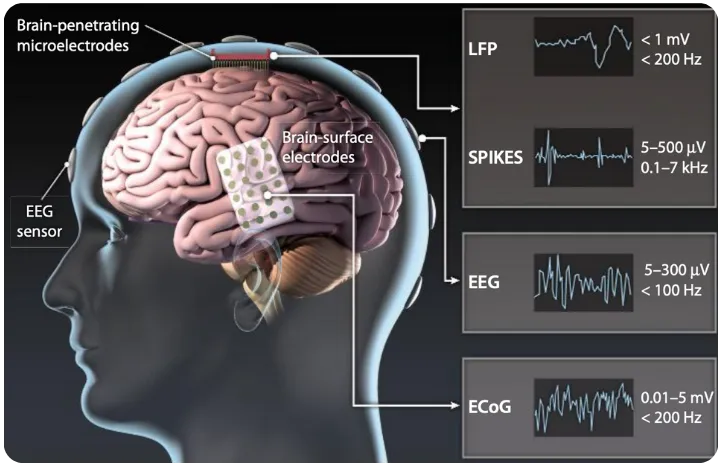
– Signal acquisition uses brain signals – primarily electrocorticogram (ECoG), local field potentials (LFP), or spike activity – recorded by fully invasive (parenchymal), semi‑invasive (subdural/extradural), or interventional (intravascular) electrodes. The guidance requires detailed specifications of electrode materials, dimensions, coating, channel count, and implantation site.
– Decoding algorithms can be rule‑based (white‑box) or data‑driven (black‑box, including deep learning). The review emphasizes generalizability, accuracy, real‑time response, and long‑term stability, with special attention to performance boundaries under signal degradation or channel loss.
– Effectors may be general electronic devices (computers, tablets), movement devices (robotic gloves, arms), or electrical stimulators (spinal cord stimulators). If multiple effectors are used, their operating modes (independent, synchronous, or mixed) and interlock/ interference controls must be validated.
Non‑clinical Testing Requirements
The guidance mandates extensive bench testing, including:
– Physical and mechanical performance – electrode tensile/flex fatigue, connector insertion/withdrawal forces, and casing seal integrity.
– Chemical and material characterization – compliance with GB/T and YY standards for pH, heavy metals, reducing substances, and corrosion resistance.
– Electrical safety and EMC – adherence to GB 16174.1 (implantables) and GB 9706 series (external parts), plus wireless coexistence and home‑use safety (YY 9706.111).
– Software and cybersecurity – software is rated as “severe” level; submissions must include full software/cybersecurity reports and, critically, a dedicated AI report for decoding algorithms. This report must cover algorithm design, dataset construction, labelling, performance evaluation, and a life‑cycle quality control plan with individualized training, performance monitoring, and retraining triggers.
– Biocompatibility – endpoints depend on contact type and duration. For electrodes in contact with neural tissue, blood, or cerebrospinal fluid, tests include cytotoxicity, sensitization, irritation, acute/subacute/chronic toxicity, implantation, genotoxicity, carcinogenicity, neurotoxicity, and hemocompatibility. Specific brain implantation and neurocytotoxicity tests are required for electrodes touching brain tissue.
– Sterilization, pyrogenicity, and cleaning – sterilization must achieve a SAL of 10⁻⁶; EO residuals and bacterial endotoxin limits are specified.
– Animal testing – mandatory before clinical trials. Small animals may be used for feasibility; large animals (pig, sheep, dog) are required for long‑term safety and reliability with a follow‑up of at least 1 year; non‑human primates are recommended for fine motor control studies. Endpoints cover surgical feasibility, tissue response, electrode integrity, signal stability, and overall system durability.
– Human factors and usability – given the high‑risk nature, a usability engineering report is required, especially for home use and caregiver tasks. Critical tasks must be performed correctly without use errors.
– Stability studies – both shelf life and service life must be determined via accelerated/real‑time aging, fatigue testing, and environmental tests (temperature, humidity, altitude).
Clinical Evaluation and Labelling
The device requires a formal clinical trial approval (Investigational Device Exemption) before human studies. Clinical protocols must collect additional data on electrode reliability, signal stability, decoding performance decay, and patient mental burden.
The labelling must include detailed instructions for training, calibration, effector operation, and MRI safety warnings if applicable. Contraindications and pediatric adaptations are also addressed.
Additional Technical Considerations
– Registration units: Different electrode sites or signal types constitute separate units; effectors must generally be included in the same application.
– MRI conditional safety: If the device is MR‑conditional, specific testing per Chinese guidance is required.
– Pediatric design: Special ergonomic and developmental considerations are needed for children.
– Mental burden monitoring: Continuous assessment of cognitive load and psychological impact is recommended.
– Post‑market surveillance: Manufacturers must monitor electrode reliability and decoding stability after launch and update designs as needed.
Overall, this guidance sets a high bar for both non‑clinical and clinical evidence, with a forward‑looking emphasis on AI algorithm validation and long‑term in vivo performance.
Takeaways from the Guideline
1. Integrated system validation
The device is not assessed as separate components. The review requires that signal acquisition (electrode quality, placement, and signal fidelity), decoding algorithms (accuracy, generalizability, and real‑time response), and effector devices (precision, safety, and mode switching) are validated together as one functional system. Any mismatch or interaction failure between these three elements is considered a major risk.
2. Dedicated AI/algorithm performance requirements
For black‑box decoding models, the guidance goes far beyond general software testing. Manufacturers must define performance boundaries (minimum signal‑to‑noise ratio and minimum channel efficiency), and implement a formal lifecycle quality plan that includes individualized patient training, scheduled performance monitoring, and predefined retraining triggers. This ensures that algorithm decay or sudden drift is detected and corrected during chronic use.
3. Rigid preclinical‑clinical requirements
Before any human study, the device must pass a mandatory preclinical phase that includes at least one year of large‑animal follow‑up to confirm long‑term safety and reliability. Subsequently, a separate formal clinical trial approval (Investigational Device Exemption) is required. Throughout clinical use, sponsors must actively collect data on performance degradation over time and the patient’s cognitive/psychological burden – both of which are integral to the benefit‑risk judgement.
Key Differences Between NMPA and FDA Guidance
1. Algorithm and software oversight
NMPA imposes mandatory, quantitative validation for black‑box AI decoding algorithms – requiring performance boundaries, stability analysis, and a retraining quality plan. FDA (2021 guidance) treats software mainly by “level of concern” and does not have dedicated AI validation provisions, reflecting its earlier publication and more generalized approach.
2. Animal testing duration and specificity
NMPA explicitly demands at least one year of follow‑up in large animal models for long‑term safety and reliability, plus mandatory brain implantation and neurocytotoxicity tests for neural electrodes. FDA recommends chronic studies but does not specify a fixed duration, focusing more on stimulation safety and acute/chronic testing without a strict timeline.
3. Product architecture and registration units
NMPA enforces fixed system configurations: effectors must be submitted as part of the whole device, and different electrode types or brain signal modalities require separate registration units. FDA embraces modular “mix‑and‑match” designs, evaluating system‑level interactions without requiring all components to come from one manufacturer, which allows greater flexibility in component sourcing.
4. Clinical trial pathway and data collection
NMPA requires a formal separate clinical trial approval before any human use, akin to an IDE, but with added emphasis on collecting real‑world performance decay and patient mental burden data during the study. FDA provides a more flexible Early Feasibility Study pathway, allowing earlier human experience with less preclinical data, supported by robust benefit‑risk justifications and preference information from patients.