
In 2025, polydeoxyribonucleotide (PDRN) has rapidly emerged as one of the most closely watched bioactive materials in the global skincare and medical aesthetics industry. Across international ingredient exhibitions, functional skincare summits, and social media trend lists, PDRN has become an unavoidable keyword for brands, clinicians, and regulators alike. This momentum reflects not only growing scientific recognition of its regenerative potential, but also the coordinated push from capital markets, product developers, and consumer demand.
According to Horizon Databook, the global PDRN market reached USD 1.557 billion in 2024 and is projected to grow to USD 3.427 billion by 2030, with a compound annual growth rate of 14.1%.
China Med Device, LLC has test engineers at NMPA testing centers and seasoned RA and CRA staff to expedite your type testing and clinical needs and shorten your approval time. Email info@ChinaMedDevice.com for more information
Background: Regeneration & Anti-Aging in Aesthetic Device
PDRN is a DNA-derived biopolymer extracted mainly from the reproductive cells of salmonid species, featuring high purity, strong biocompatibility, and extremely low immunogenicity due to its high homology with human DNA. Through adenosine A2A receptor activation and the nucleotide salvage pathway, PDRN promotes fibroblast proliferation, angiogenesis, and tissue repair, while also exerting anti-inflammatory, antioxidant, and anti-photoaging effects. Compared with conventional fillers that only provide mechanical support and biostimulators that mainly induce delayed collagen remodeling, PDRN integrates “regeneration + visible skin quality improvement,” filling the functional gap between hyaluronic acid fillers and PLLA/PCL-based products. This dual-action profile explains why PDRN has rapidly evolved from a wound-healing agent in serious medical settings into a core material for regenerative aesthetics and anti-aging interventions.
NMPA Classification and Review Requirements
Product Classification
Since 2022, composite injectables containing hyaluronic acid and PDRN/PN have been explicitly classified by the NMPA as drug–device combination products primarily regulated as medical devices. This classification implies that product registration may involve dual-track technical review, covering both medical device performance and pharmaceutical safety attributes.
In the official summary of drug–device combination product attribute classifications released in 2023, a “PDRN injectable solution” submitted by Beijing-based Lilai Technology Co., Ltd. was identified as a device-led combination Class III Product. In 2024, injectable polynucleotide gels were similarly classified, indicating that regulators will systematically require pharmacological, toxicological, and immunogenicity data, as well as multi-center clinical trials, for PDRN-related injectables entering the Chinese market.
Technical Review Key Points
For injectable medical aesthetic indications, the NMPA review emphasizes several core elements. Applicants must comply with regulatory guidance for device-led combination products, with particular focus on drug release kinetics, systemic exposure, and long-term safety.
Raw material control is a major regulatory concern: applicants are required to provide full traceability of fish species and aquaculture sources, validation of viral, mycoplasma, and mycobacterial inactivation processes, DNA purity ≥95%, and residual protein content ≤0.05%.
Quality control standards must define molecular weight distribution, endotoxin limits (<0.5 EU/mL), and sterility assurance levels (e.g., SAL 10⁻⁶). Preclinical evaluation should cover biocompatibility, degradation behavior (typically complete degradation within 3–6 months), local irritation, immunogenicity, and in vivo metabolism.
Clinical trials must adopt scientifically justified indications, appropriate control groups, and statistically sound sample size calculations. Safety evaluation should include immediate post-injection reactions, mid-term adverse events, and long-term outcomes (6–12 months), supported by laboratory examinations such as blood routine tests, liver and kidney function, and immune markers to exclude systemic risks.
R&D Pipeline and Business Updates in China
Master File Registration of PDRN Raw Materials
As of early 2026, around ten Chinese companies have completed master file registration for PDRN raw materials, including leading biomaterial enterprises such as Bloomage Biotech, Imeik, and Haohai Biological Technology. The establishment of domestic PDRN master files marks a key milestone in localizing upstream supply chains and reducing dependence on imported raw materials.
Key Product-Level Developments
In 2025, the Korean PN injectable Rejuran received approval to enter the Boao Lecheng International Medical Tourism Pilot Zone as a clinically urgent imported medical device, reflecting regulatory openness to advanced regenerative injectables under controlled pilot policies.
Meanwhile, multiple domestic projects are progressing through the NMPA registration pathway. A PDRN composite injectable jointly developed by Jiangsu-based and Beijing-based companies completed patient enrollment in clinical trials in 2025. Lepu Medical’s “salmon needle” combination product has been formally accepted by the NMPA for review, with market entry expected as early as 2026, although regulatory uncertainty remains due to the absence of precedent approvals. Viplu Medical has submitted a Class III injectable combining type III collagen and PDRN, while several Class III PDRN injectables from Hainan-based enterprises have entered formal registration.
Upstream innovation is also accelerating. Bloomage Biotech has disclosed patents covering specific nucleic acid sequences and their application in PDRN products. In parallel, Ruijiming Biotech announced in 2025 the development of the world’s first recombinant salmon PDRN raw material, potentially redefining future sourcing models and regulatory expectations for biological safety and batch consistency.
Case Study
Below is an example of product classification application of a PDRN injectable. It is classified by NMPA as a device-led combination product, Class III.
Intended Use
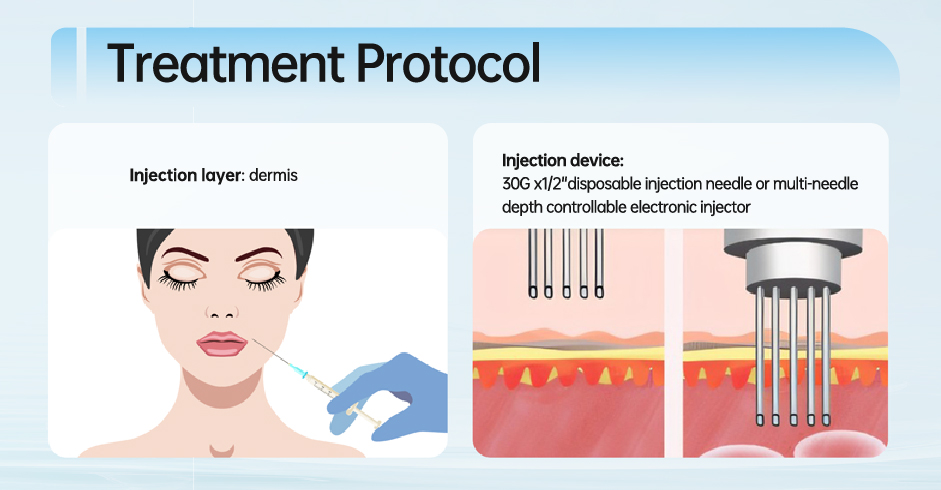
For intradermal injection into the dermis to correct moderate to severe neck wrinkles.
Composition
The product consists of a prefilled syringe, a stainless-steel injection needle, and a composite solution contained in the prefilled syringe. The composite solution mainly includes polydeoxyribonucleotide (PDRN), type I collagen, L-carnosine, glycine, alanine, proline, vitamin B2, and water for injection. The type I collagen is purified from porcine skin with a labeled concentration of 5 mg/mL; the PDRN is derived from salmon reproductive cells with a labeled concentration of 1 mg/mL.
Mechanism of Action
This product functions as a dermal tissue filler to correct wrinkles by filling the skin. The mechanisms of the main components are as follows:
Type I Collagen: Collagen is a major structural component of the dermis. Type I collagen is particularly abundant in the reticular dermis, where collagen fibers and elastic fibers form a network structure. These fibers support the overall architecture of the skin while providing necessary elasticity and flexibility.
Polydeoxyribonucleotide (PDRN):
PDRN is a DNA fragment extracted from the reproductive cells of salmon or other salmonid species. Its main mechanisms include:
- Promotion of cellular regeneration and repair: PDRN activates adenosine A2A receptors, promotes fibroblast proliferation, enhances the skin’s self-repair capacity, improves damaged tissues, and strengthens the skin barrier function.
- Stimulation of collagen and hyaluronic acid synthesis: PDRN increases fibroblast activity and promotes the synthesis of type I collagen, type III collagen, and hyaluronic acid, making the skin fuller and more elastic, thereby reducing wrinkles.
- Anti-inflammatory and antioxidant effects: PDRN reduces chronic skin inflammation and free radical damage, and helps repair UV-damaged skin, improving photoaging.
- Improvement of microcirculation: By promoting angiogenesis, PDRN enhances oxygen and nutrient supply to the skin, improves skin tone, and makes the skin appear healthier and more radiant.
Strategic Implications for NMPA Registration
PDRN/PN materials, characterized by high biocompatibility, multi-pathway regenerative mechanisms, and favorable safety profiles, are becoming core regenerative materials in medical aesthetics following hyaluronic acid, collagen, and PLLA/PCL. While international markets already feature mature product portfolios, China is entering a decisive stage of regulatory translation and industrial upgrading. The period from 2026 to 2027 is expected to witness the first approvals of domestically developed PDRN injectable products under the NMPA framework, potentially inaugurating a new era of locally manufactured “salmon needle” products.
For enterprises preparing for NMPA registration, several strategic priorities are recommended:
- Engage early in product attribute classification to clarify positioning as a device-led combination product.
- Strengthen preclinical research, particularly in optimizing PDRN purity, molecular weight distribution, and degradation profiles.
- Design robust, differentiation-oriented clinical trials aligned with international benchmarks while addressing China-specific regulatory expectations.
- Initiate early-stage market education to build the narrative of “regenerative repair” rather than traditional filling, supporting long-term clinical and commercial adoption.