
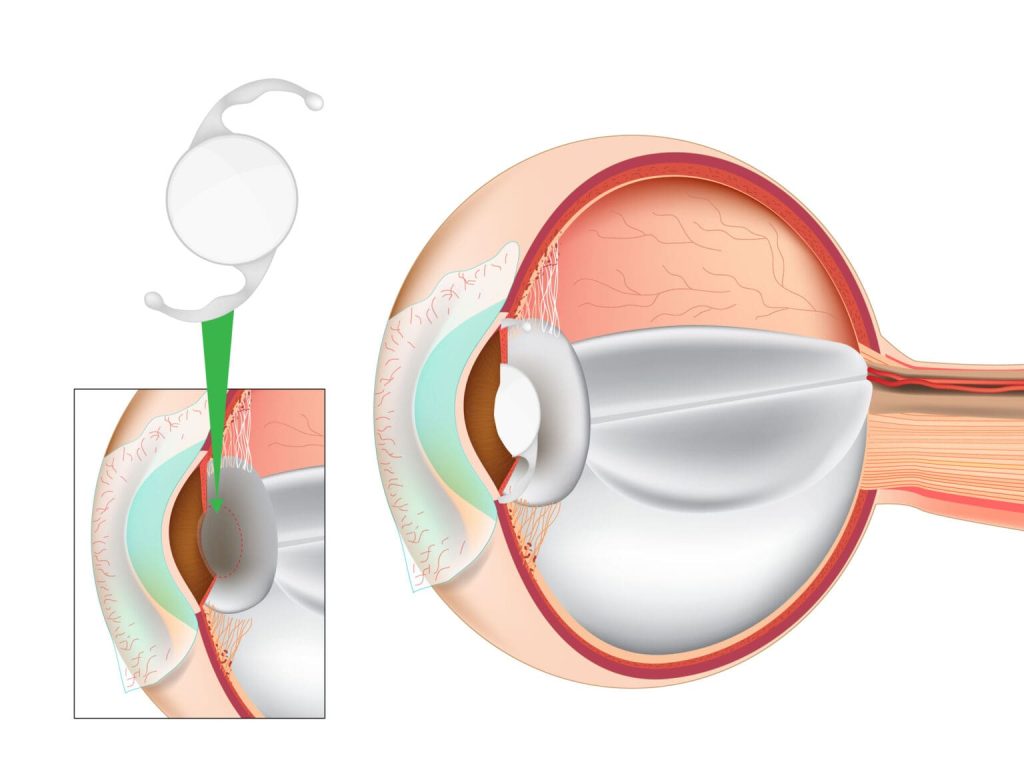
Cataract remains one of the most common ophthalmic diseases in China, largely driven by the country’s rapid demographic transition toward an aging society. Epidemiological reports indicate that more than 80% of individuals aged 60 to 89 in China show varying degrees of lens opacity. Among those aged over 90, the prevalence approaches near universality. Current estimates suggest that China hosts more than 200 million cataract patients, and approximately 400–500 thousand new cases are diagnosed each year. Surgical intervention is the only proven effective treatment, and more than 4 million cataract surgeries are performed annually in China.
Please click HERE for devices and equipment for cataract treatment with NMPA approvals list.
For recent developments in China ophthalmic market, click HERE
At the core of cataract surgery is the implantation of an intraocular lens (IOL). The design, optical properties, and material characteristics of the IOL directly affect postoperative visual outcomes. As expectations for functional vision continue to rise, patients increasingly seek improved intermediate vision, reduced dependence on glasses, and more stable visual performance across different scenarios. Traditional monofocal IOLs can restore distance vision but often fall short in meeting the needs of daily activities that require intermediate-range clarity, such as reading mobile phones, cooking, or computer use.
In this context, new generations of IOLs—particularly extended depth-of-focus (EDOF) lenses and lenses incorporating new polymer materials—have attracted significant clinical and regulatory attention. In September and October 2025, the NMPA released three evaluation reports for innovative IOL products that had obtained approval. The close timing and concentrated release of these documents reflect a growing interest in advanced IOL technologies and highlight the regulator’s intention to guide and standardize development in this product category.
This technical report analyzes the key regulatory pathways, evidence requirements, and strategic considerations demonstrated in these three NMPA-approved products: two extended depth-of-focus IOLs and one crosslinked polyisobutylene aspheric monofocal IOL. The analysis focuses on product positioning, non-clinical evaluation, clinical research design, risk control strategies, and critical decision points for registration success. The aim is to provide a structured and practical reference for companies developing or planning to register similar high-risk Class III medical devices in China.
- Product Positioning and Technical Characteristics
Although all three products share the same clinical indication—“visual correction in aphakic adult patients after cataract extraction”—their design principles and technical attributes differ significantly. These differences determine the regulatory rationale, the key evaluation endpoints, and the overall registration strategy.
1.1 Extended Depth-of-Focus (EDOF) Intraocular Lenses
The two EDOF IOLs analyzed in the NMPA reports target the improvement of intermediate vision and reduction of spectacle dependence. Their purpose is not merely to restore distance vision but to broaden the focus range to cover intermediate distances.
1.1.1 Optical Design Principles
Although both products aim to extend depth of focus, they adopt different optical strategies:
(1) High-order aspheric design (no diffractive rings)
The product from Aibo Nuode adopts a high-order aspheric front surface and a spherical back surface. This asymmetry adjusts the distribution of spherical aberrations to create an extended focal range. The lens has no diffractive rings, which may help reduce light-splitting–related issues such as glare and halos.
(2) Diffractive–aspheric hybrid design
The product from Tianjin Shiji Kangtai uses an aspheric base profile combined with diffractive rings. The diffractive structure generates multiple diffraction orders that contribute additional optical power, effectively increasing the range of clear vision. This pathway represents a widely adopted EDOF design in global practice.
Although the optical mechanisms differ, both engineering routes aim to offer a continuous and stable visual performance from distance to intermediate ranges, without substantially compromising distance vision.
1.2 Crosslinked Polyisobutylene Aspheric Intraocular Lens
The product from Xi’an Yandele represents a material-innovation pathway. Rather than emphasizing new optical function, it focuses on improving safety, stability, and biocompatibility through the adoption of a new hydrophobic crosslinked polyisobutylene (PIB) material.
1.2.1 Material Characteristics
Polyisobutylene is known for favorable properties such as:
- high chemical stability
- low water absorption
- suitable flexibility for folding and injection
- good biocompatibility
From a regulatory perspective, introducing a new implantable material places emphasis on long-term safety and degradation behavior. Consequently, the evaluation strategy must demonstrate that the material does not release harmful substances in the intraocular environment and that optical performance remains stable after implantation.
1.2.2 Optical Design
The lens adopts a monofocal aspheric optic primarily aimed at correcting spherical aberration and improving contrast sensitivity, particularly under low-light conditions. The product does not claim functional advantages such as intermediate enhancement; therefore, clinical evaluation focuses on demonstrating non-inferiority to existing monofocal IOLs.
2. Non-Clinical Evaluation: Foundation of the Registration Pathway
The three NMPA evaluation reports demonstrate that a comprehensive non-clinical evidence package is essential for innovative IOL products. Based on the content of the reports, non-clinical evaluation generally encompasses four major domains:
- optical performance
- mechanical and physical performance
- biocompatibility and material characterization
- sterilization validation and shelf-life evidence
2.1 Optical Performance Testing
Optical testing is the core component of IOL performance evaluation. For the EDOF lenses, optical evidence must directly demonstrate the intended function of extended depth of focus. For the PIB monofocal lens, optical testing verifies basic effectiveness and optical quality.
2.1.1 Depth-of-Focus–Related Metrics
Both EDOF products provided several key metrics not required in routine monofocal evaluations:
- modulation transfer function (MTF) as a function of defocus
- depth-of-focus range derived from MTF thresholds
- MTF under tilt and decentration conditions
- spherical aberration distribution
- simulated functional vision under different pupil sizes
These data collectively reflect how the lens maintains usable image quality across varying focal distances and under potential postoperative misalignment scenarios.
2.1.2 Material-Innovation IOL Optical Tests
The PIB IOL focused on:
- power accuracy
- image quality (MTF at nominal focus)
- spherical aberration characteristics
- spectral transmittance
Additionally, because the material is new to the Chinese market, degradation-behavior testing and chemical characterization of potential leachables were included.
2.2 Mechanical and Physical Performance
To ensure long-term stability after implantation, all products completed tests such as:
- lens diameter, thickness, and haptic dimensions
- compression force
- axial displacement
- dynamic fatigue tests
- optic decentration and tilt
- injector compatibility (for preloaded systems)
These tests simulate the physical stresses lenses experience during implantation and extended residence within the capsular bag.
2.3 Biocompatibility and Toxicological Evaluation
All three products followed the GB/T 16886 series and YY/T 0290.5. The selection of endpoints reflected long-term ocular implantation.
2.3.1 Required Endpoints for IOL Optics
Most products completed:
- cytotoxicity
- sensitization
- genotoxicity
- acute systemic toxicity
- eye irritation
- intracameral implantation tests
- local tissue reaction evaluation
Two of the products (including the PIB lens) also provided:
- subchronic toxicity studies
- chronic toxicity or carcinogenicity studies
These higher-level evaluations provide assurance of long-term intraocular safety, which is particularly important when new materials or new optical structures are involved.
2.3.2 Biocompatibility of Injectors
For injector components, which have transient contact with ocular tissues, a reduced set of endpoints was considered adequate, typically including cytotoxicity, sensitization, eye irritation, acute systemic toxicity, and pyrogen tests.
2.4 Sterilization, Packaging, and Shelf-Life
All three products use ethylene oxide (EO) sterilization, with a sterility assurance level (SAL) of 10⁻⁶. Each product provided:
- sterilization validation
- EO and ECH residuals data
- aging studies (accelerated and real-time)
- packaging integrity testing
- transportation simulation testing
Shelf-life claims ranged from three to five years depending on the product. NMPA placed clear emphasis on showing that optical and mechanical performance would remain stable throughout the claimed shelf-life.