
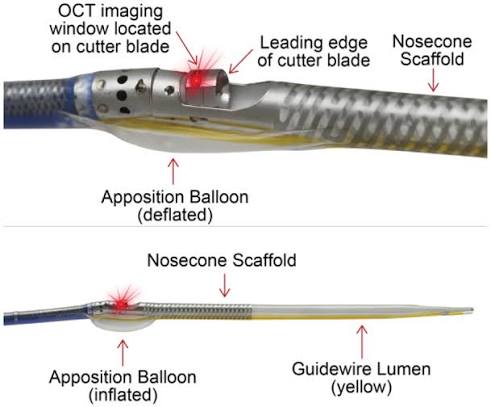
In August 2026, the NMPA issued four announcements suspending the import, distribution, and use of specific medical devices from Coloplast A/S (Denmark), Avinger, Inc. (USA), Eurocor Tech GmbH (Germany), and Laurus Optics Limited (UK). The suspensions, effective immediately, follow NMPA’s on‑site or remote inspections, which found that the manufacturers’ quality management systems (QMS) failed to meet China’s current Medical Device Production Quality Management Standard (the 2014 GMP) – the regulation still in force until 31 October 2026.
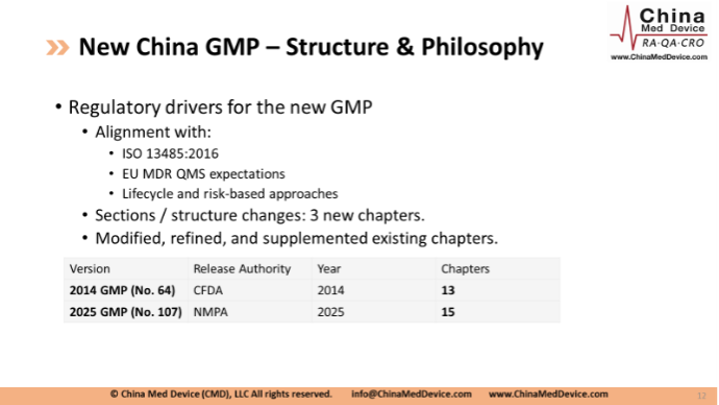
These enforcement actions come at a critical time, as China is transitioning to a revised GMP that will take full effect on 1 November 2026. Although the current suspensions are based on the existing 2014 framework, the deficiencies identified – ranging from documentation and design control to quality assurance and batch release – are precisely the areas where the new GMP introduces more prescriptive, standalone requirements with heightened compliance expectations. The August cases serve as an early warning for overseas manufacturers.
For our recorded webinar on China new GMP, click HERE
For inspection results in May about KARL STORZ, please click HERE
China Med Device Cited by RAPS on NMPA Overseas Inspection. Click HERE for the article
Click HERE for the list of devices mentioned in the 2026 National Inspection Plan
Overview of the August 2026 Suspensions
| Manufacturer | Country | Products Suspended | Cited QMS Deficiencies |
| Coloplast A/S | Denmark | Foam dressings (Biatain) | Deficiencies in design development and quality control. |
| Avinger, Inc. | USA | Pantheris® catheter, Pantheris SV® catheter, Lightbox®3 OCT console | Failure to submit required authorisation letters, product information forms, and site master files within the prescribed timeframe; deemed non‑compliant with GMP requirements. |
| Eurocor Tech GmbH | Germany | Paclitaxel‑eluting PTA balloon catheter | Deficiencies in product inspection and release review. |
| Laurus Optics Limited | UK | Ophthalmic surgical knives | Deficiencies in key personnel performance, design development, production management, quality control, and product release. |
1. Documentation and Data Integrity: The Avinger Case
Avinger’s suspension is notable for its procedural root cause: the company did not provide the required documentation to facilitate the NMPA’s on‑site inspection. Under China’s Regulations on Overseas Inspection of Drugs and Medical Devices, refusal or obstruction of inspection, or failure to supply authentic documents, can directly result in a non‑compliance judgment.
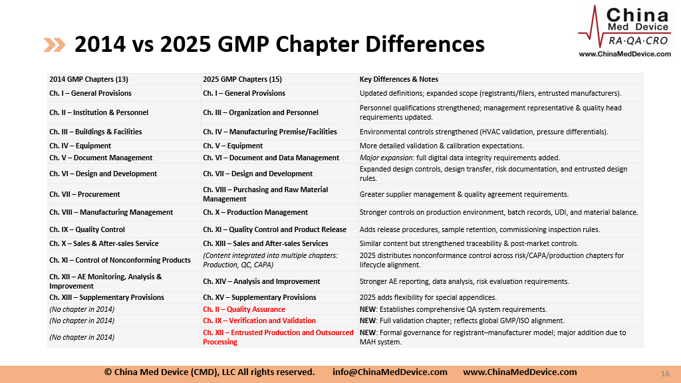
This directly implicates Chapter VI (Document and Data Management) of the new GMP. The revised regulation mandates robust document‑control and record‑keeping procedures, ensuring that all quality‑system documents are properly authorized, distributed, and maintained. It also places special emphasis on electronic records and data integrity, requiring that data be authentic, accurate, complete, traceable, and backed up. Avinger’s failure to deliver a site master file and other critical documents signals a systemic breakdown in transparency and record‑keeping—a red flag that under the new GMP would be treated as a severe violation, possibly triggering immediate regulatory action even without a physical inspection.
2. Design Controls and Quality Assurance: Coloplast and Laurus Optics
Both Coloplast and Laurus Optics were cited for deficiencies that span design development and quality control, with Laurus additionally flagged for inadequate performance of key personnel.
These issues directly correlate with two major pillars of the new GMP:
– Design Development (Chapter VII) – The 2025 GMP introduces more rigorous requirements for design planning, input, output, verification, validation, transfer, and change control. It explicitly mandates that risk management be integrated throughout the design process. Coloplast’s design‑related deficiencies suggest that the company may not have adequately validated its foam dressing design or controlled subsequent changes, while Laurus’s broader design flaws indicate insufficient design review and validation procedures.
– Quality Control and Personnel (Chapters XI and III) – The new regulation establishes a separate chapter on quality control, setting detailed standards for inspection protocols, sampling, and laboratory management. It also tightens qualification and responsibility requirements for key personnel, such as the management representative, quality head, and release authorizer. Laurus’s failures in “key personnel performance” reflect exactly what the new GMP seeks to prevent: insufficiently qualified or inadequately independent staff who cannot effectively oversee quality. Both companies’ quality‑control lapses show that the NMPA is now scrutinizing not just final product testing, but the entire quality‑assurance ecosystem.
3. Product Inspection and Release Review: Eurocor Tech
Eurocor Tech’s cited deficiencies—specifically in product inspection and release review—mirror those of Coloplast and Laurus but are especially concerning because they affect the final gateway before market entry.
The new GMP (Chapter XI, Quality Control and Product Release) addresses these issues in detail:
– Article 100 requires that each batch (or unit) have complete inspection records that are traceable, covering raw materials, in‑process checks, and finished product tests.
– Article 104 outlines the product‑release procedure, mandating that a designated, authorized person review all production and quality records and formally sign off on the batch before release.
Eurocor Tech’s deficiencies indicate either that its inspection protocols were incomplete, that records were not properly maintained, or that the release review was not conducted with sufficient independence and rigor. Under the new GMP, the release authorizer must be a quality‑management professional with defined qualifications and clear authority—and the release decision must be fully documented, including any deviations and their dispositions. Any shortcut in this process would be considered a critical non‑conformity.
What This Means for Overseas Manufacturers During the Transition
The August 2026 suspensions are a clear warning: the one‑year transition period to the new GMP is not a grace period—it is an enforcement ramp‑up. The NMPA continues to conduct overseas inspections under the existing 2014 GMP, but the deficiencies it is detecting are precisely the areas that the 2025 GMP will elevate to even stricter, codified standards.
For international manufacturers exporting to China, these cases highlight several imperatives:
1. Conduct a gap assessment against the new GMP immediately– Do not wait until November 2026. Review your documentation, design controls, validation/verification processes, QC protocols, and personnel qualifications against the new requirements.
2. Ensure inspection‑readiness – Avinger’s case shows that non‑cooperation or delayed documentation is unacceptable. Establish a clear internal process to respond to NMPA inspection requests within the stipulated timeframes.
3. Strengthen process validation and quality monitoring – The new GMP’s standalone Validation and Verification chapter (Chapter IX) demands rigorous proof that special processes and key processes are consistently controlled. Ensure that revalidation protocols are in place for any changes.
4. Empower quality functions and release authorizer– The new regulation enhances the independence and accountability of quality personnel. Review your organizational structure to ensure that quality leaders have the authority, competence, and resources to fulfil their duties without interference.